
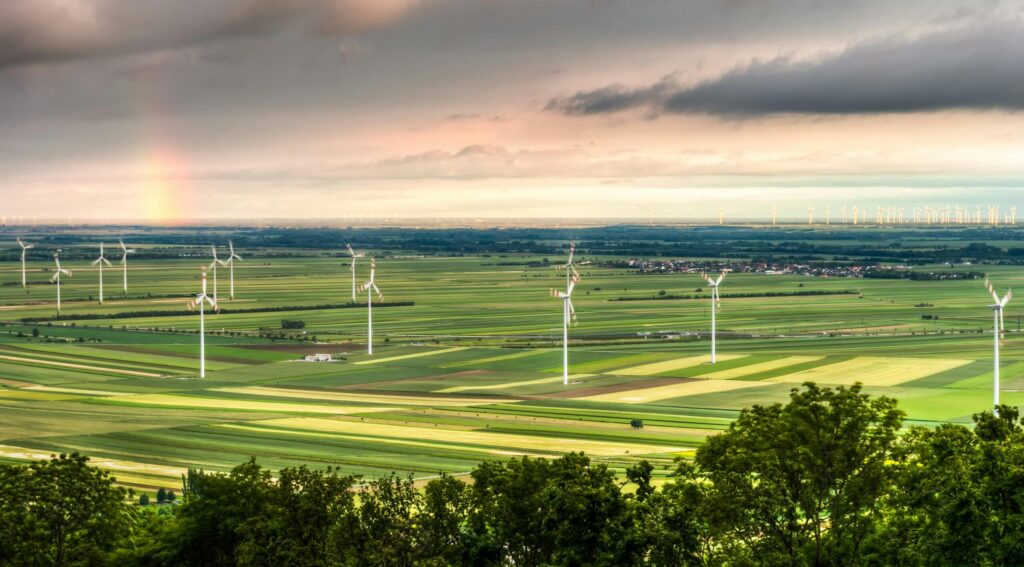
- Portugal’s government has designated 1,302 priority zones – 792 for solar and 510 for wind – near existing grid connections to accelerate renewables development.
- The Green Map aims to streamline permitting by focusing projects within 10 km of transmission lines and avoiding areas with high environmental constraints; a public consultation runs until mid-July.
- Solar capacity has risen from about 1 GW in 2016 to nearly 7 GW in 2025, while wind capacity stands around 5.6 GW; renewables supplied roughly 80 percent of Portugal’s electricity in the first quarter of 2026.
Portugal has spent the past decade quietly building one of Europe’s greenest power systems, but its next leap forward will require cutting through red tape.
Lisbon’s energy ministry this week published a ‘Green Map’ of priority areas for new onshore wind and solar projects, a move designed to speed up environmental approvals and attract investment.
The map identifies 1,302 zones – 792 earmarked for utility-scale solar arrays and 510 for wind farms – all within 10 km of existing transmission lines. Projects in these zones will benefit from simplified permitting and reduced environmental impact assessments, while developments outside the zones will face stricter scrutiny.
A public consultation on the plan runs until mid-July, with final approval expected before the end of the summer.
The Green Map responds to a conundrum familiar across Europe: the pipeline of renewable projects dwarfs the rate at which they are authorised and connected. Portugal has seen solar capacity expand from roughly 1 GW in 2016 to nearly 7 GW by 2025; wind capacity has climbed to about 5.6 GW.
In the first quarter of this year, renewable sources met around 80% of the country’s electricity demand. But grid constraints and lengthy licensing processes have begun to slow progress. Energy Secretary Ana Fontes told local media that nearly 25 GW of projects are awaiting approval and that the map will help prioritise those that can be built quickly without significant ecological impact.
Under the scheme, developers will still need to conduct environmental studies and consult local communities, but the government will provide a pre-approved framework to shorten the timeline. Each zone was selected based on grid proximity, land availability and biodiversity assessments.
Areas overlapping with protected habitats or prime agricultural land are excluded, as are zones where cumulative noise or visual impacts would be high. Officials hope the approach will channel capital into projects that can connect to the grid quickly, reducing the risk of stranded assets.
The initiative is part of a broader European movement to accelerate permitting. The EU’s Renewable Energy Directive now requires member states to identify “go-to” areas where projects can be fast-tracked, and Portugal is among the first to publish a detailed map.
Italy’s Confindustria recently warned that 130 GW of renewable projects remain stuck in permitting; Germany has slashed red tape for onshore wind; and France is mapping industrial zones for solar. By aligning its map with available grid capacity, Portugal hopes to avoid the bottlenecks that have hampered northern European markets.
‘Green’ confidence
Investors have welcomed the clarity. Utility EDP said the Green Map gives it confidence to invest in new solar clusters without waiting years for approvals. The Portuguese Renewable Energy Association said the plan could unlock €10 billion in investment over the next decade and help the country exceed its 2030 target of 80% renewables in electricity supply.
Critics caution that accelerating permitting must not weaken environmental safeguards or community engagement; they note that many of the designated areas are in rural regions where solar farms have faced opposition.
Britain’s offshore wind sector has thrived under clear contracts for difference auctions, but onshore wind and solar projects often face planning delays. A Green Map style approach could be used to identify zones near substations where projects could proceed with minimal objections. It would also dovetail with the government’s new Supply Chain Fund, which is targeting domestic manufacturing.
As energy costs and security concerns drive governments to speed the transition, Portugal’s experiment with pre-approved renewable zones may become a blueprint for others.
Ultimately, the Green Map is a gamble that planning certainty can deliver a second wave of renewable build-out without sacrificing local consent. If successful, it could reinforce Portugal’s reputation as Europe’s clean energy pioneer and highlight the role of smart regulation in turning ambition into kilowatt hours.