
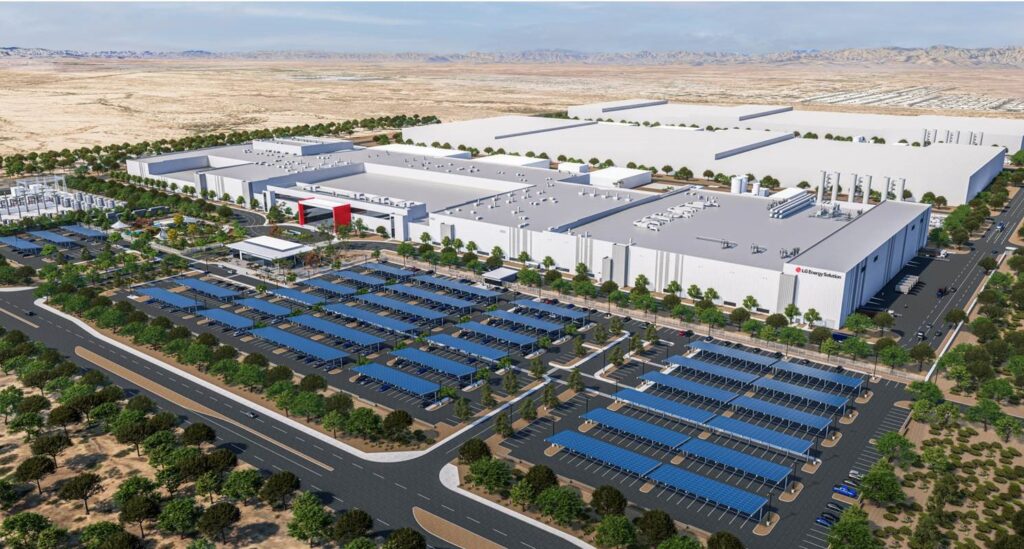
- LG Energy Solution plans to lift North American stationary storage manufacturing capacity above 70 GWh by the end of 2027.
- Converting existing vehicle battery lines provides a route to expansion alongside investment in new production formats.
- UK buyers may gain supplier choice, but regional sourcing rules and competing demand will influence prices and availability.
LG Energy Solution plans to expand North American stationary battery manufacturing capacity to more than 70 GWh by the end of 2027, as growing demand from electricity networks and AI data centres influences how it allocates production investment.
The South Korean manufacturer said on 3 November that it would convert additional electric vehicle pouch-cell lines to energy storage and establish new prismatic battery production lines. The target concerns manufacturing capacity, rather than batteries already installed or confirmed annual deliveries.
The company also reported its first direct battery storage supply project for a major technology customer. It said qualification as an NVIDIA DSX Ready battery storage partner would support further opportunities in the data centre market.
The expansion follows a recovery in quarterly trading. LG reported revenue of approximately KRW9.6tn, up 27.6% from the preceding quarter, and operating profit of KRW756bn. It attributed the improvement partly to increased storage shipments and better utilisation of production facilities.
Independent reporting by Aju Press nevertheless highlighted a net loss for the quarter and the substantial contribution of North American manufacturing incentives to operating profit. The results therefore show stronger activity alongside continuing financial pressures.
A separate materials agreement illustrates the supply chain investment behind the expansion. L&F said it would supply LG Energy Solution with KRW1.035tn of lithium iron phosphate cathode materials over four years from 2028, extending a relationship previously centred on nickel-based products.
Regional supply differentiator
The expansion indicates that stationary storage has become a substantial destination for battery manufacturing capital. Converting existing lines can provide a different investment route from building an entirely new factory, although successful conversion still depends on product qualification, production yields and customer acceptance.
For UK buyers, the attraction is a potentially broader supply base. More competition among established manufacturers could improve negotiating options for projects seeking equipment, performance guarantees and long-term service support.
However, North American capacity should not be assumed to serve the British market on equivalent terms. LG’s strategy is explicitly responding to demand for locally produced equipment and supply chains that meet US restrictions involving designated foreign entities.
That can divide the market into regional pools, with different material sources, qualification requirements and pricing. A buyer comparing offers therefore needs to understand which factory will make the product, how its inputs are sourced and whether the proposed delivery slot is committed.
The new L&F agreement is relevant because expanding cell assembly alone does not secure the materials required to sustain output. Cathode supply, customer qualification and manufacturing ramp-up must progress together. Contracted materials can strengthen that chain, but delivery obligations begin later in the decade.
The AI opportunity also requires scrutiny. A battery serving a data centre can support reliability and power management, but does not guarantee the firm generation needed to operate the facility. Its value depends on the wider electrical design and the services the customer requires.
For developers and investors, the useful indicators will be commissioned factory capacity, actual shipments and durable customer contracts. Announced manufacturing capability creates options; consistent production and reliable equipment performance determine whether those options translate into lower project costs and a more resilient storage supply chain.