

Why energy security is once again driving the agenda
The week beginning 4 May 2026 marked an inflection point for the global energy transition.
Across Europe and North America, policymakers, utilities and investors continued to pursue decarbonisation at pace. But increasingly, the transition is being reframed through a different lens: energy security, industrial resilience and economic competitiveness. That shift was visible everywhere.
The EU moved towards softening methane enforcement rules in the name of supply security. Germany doubled down on industrial decarbonisation subsidies to protect manufacturing competitiveness. Oil and gas prices remained elevated amid continuing Middle East instability. Meanwhile, utilities accelerated consolidation, battery storage deployment surged and nuclear projects gained fresh momentum.
The message is becoming clearer by the week: the transition is no longer simply about emissions reduction. It is now fundamentally about geopolitical resilience, infrastructure flexibility and industrial strategy.
Policy & Regulation
- UK moves to decouple electricity prices from gas. The government announced voluntary Wholesale Contracts for Difference (WCfDs) for existing low‑carbon generators and will raise the Electricity Generators Levy from 45% to 55% from July 2026. The aim is to reduce the share of hours when gas sets power prices from 60% to 50% by 2030, covering roughly one‑third of Britain’s power supply. This initiative is designed to insulate consumers from volatile gas markets and incentivise older wind and solar projects to accept fixed prices. It also raises funds for schemes such as Great British Energy.
- EU may weaken methane‑emissions rules. Leaked European Commission guidance suggests national authorities could exempt fossil‑fuel producers from methane‑emissions penalties on energy‑security grounds. The move could slow global methane‑reduction efforts and reduce pressure on UK gas producers, reflecting how security concerns are trumping climate ambition amid the Middle East conflict.
- Free CO₂ allowances extended for EU industries. The European Commission proposed maintaining about 75% free allocation of emissions permits for energy‑intensive industries through 2030, which could save companies €4 billion. This slows the pace of carbon pricing and may affect the competitiveness of UK steel and chemicals firms if Britain does not mirror the support.
- Germany’s €5 billion CCfD scheme. Germany will offer Carbon Contracts for Difference (CCfDs) worth €5 billion to help heavy industry deploy low‑carbon technologies, including carbon capture and storage. The contracts compensate companies for the extra cost of using green hydrogen or CCS. UK policymakers could adopt similar mechanisms for decarbonising steel, cement and chemicals.
- Norway reopens gas fields and ramps up exploration. Norway has reopened three long‑closed North Sea gas fields and approved exploration at 70 new sites. The decision boosts European gas supply, potentially easing prices, but also prolongs the region’s dependence on fossil fuels.
- Investors flock to clean‑power funds. Clean‑energy investment funds attracted more than £3 billion in April, taking total assets to around $43 billion. The influx reflects investors seeking hedges against fossil‑fuel volatility and could support more renewable projects in the UK.
- Europe invests nearly €200 billion in EV battery capacity. A study reported that the European Economic Area and Switzerland have committed almost €200 billion – largely into the battery supply chain – and Europe now produces batteries for about one‑third of EVs sold domestically. This investment will shape demand for critical minerals and influence the competitiveness of the UK’s EV sector.
- Battery‑paired renewable projects to surge. Aurora Energy Research projects that Europe’s co‑located solar‑ and wind‑with‑storage capacity will rise from 6.3 GW in 2025 to roughly 35 GW by 2030. Returns are highest in Germany, followed by Britain and Bulgaria. Although curtailment is expected to rise sharply, the growth of hybrid projects could reduce price volatility.
Deals & Corporate Moves
- E.ON to acquire OVO Energy. E.ON announced plans to buy OVO, adding four million customers to its 5.6 million UK base. The deal aims to achieve scale and invest in smart tariffs, home batteries and electric‑vehicle integration. It marks a significant consolidation in the UK retail market and could accelerate flexible tariff offerings.
- Brookfield & The Nuclear Company revive VC Summer reactors. A joint venture will resume construction of the abandoned AP1000 reactors in South Carolina using Westinghouse technology and AI‑driven project management. This signals renewed investor interest in large nuclear projects and offers supply‑chain opportunities for UK firms.
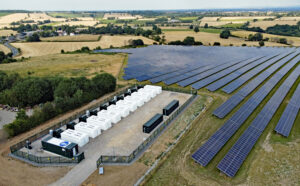
- Longroad Energy’s Sun Pond project goes live. Longroad Energy commissioned the Sun Pond project in California, pairing a 111 MW solar farm with an 85 MW/340 MWh battery. The plant supplies local community energy agencies and will avoid about 145 000 tonnes of CO₂ annually. The project demonstrates the commercial viability of large solar‑plus‑storage plants, aligning with IRENA’s findings on firm renewable power.
Technology & Innovation
- Hybrid renewables match or beat fossil costs. The International Renewable Energy Agency (IRENA) reported that solar and wind‑with‑battery solutions now deliver round‑the‑clock power at USD 54-82/MWh, cheaper than new coal in China and new gas globally. Wind‑plus‑storage costs are projected to fall to USD 49-75/MWh by 2030. This challenges assumptions about firm renewable power costs and supports UK efforts to develop 24/7 power purchase agreements.
- US DOE backs industrial decarbonisation. The US Department of Energy awarded $52 million to 20 projects developing technologies such as advanced heat pumps, low‑carbon cement, polymer‑composite heat exchangers and AI‑powered cement blending. These innovations could inform UK industrial strategy.
- Advanced nuclear projects gain momentum. Kairos Power began building a 50 MW molten‑salt reactor in Tennessee, TerraPower started a 345 MW sodium‑cooled reactor in Wyoming, and Holtec plans to restart the shuttered Palisades plant. The projects demonstrate a US nuclear revival and offer lessons for the UK’s small modular reactor ambitions.
- Largest HALEU shipment delivered. The US, Japan and UK Nuclear Transport Solutions shipped 1.7 tonnes of high‑assay low‑enriched uranium (HALEU) for advanced reactors. HALEU supply is critical for next‑generation nuclear designs, and the UK’s involvement highlights its role in the global fuel cycle.
- AI growth pressures corporate clean‑energy goals. Microsoft is reportedly reconsidering its goal of matching 100% of its electricity use with clean energy by 2030 because AI data‑centre demand is driving up power consumption. The company continues to sign large carbon‑free power deals but may delay its target, signalling how AI could upend corporate renewable pledges.
Markets & Prices
- Gas and oil prices remain elevated. UK day‑ahead gas traded at 116.65 pence per therm and Dutch TTF gas at 122.12 pence per therm (about €48.28/MWh) in early May, around 35% higher than a year earlier. European gas storage levels were 34% full versus a five‑year average of 42%, highlighting supply risks. Brent crude was $101.77/bbl, up 9.6% month‑on‑month and 70% year‑on‑year.
- Wholesale power prices steady. Irish wholesale electricity averaged €131.14/MWh as of 5 May 2026, showing stable prices despite Middle East tensions. Stability suggests that renewable output and mild demand are offsetting higher fuel costs.
- Offshore wind faces headwinds. Rising costs and supply‑chain challenges have made European developers more cautious, with under‑subscribed auctions in the UK, Germany, the Netherlands and France. The trend may slow capacity additions and push up strike prices in upcoming UK Contracts for Difference auctions.
Other noteworthy developments
- Santa Marta fossil‑fuel transition conference. Over 50 countries, excluding China, the US and India, met in Colombia to form a “coalition of the willing” for phasing out fossil fuels. France committed to cutting its fossil‑fuel share to 40% by 2030 and 30% by 2035, and to phase out coal by 2027 and oil by 2045.
- Renewables save the UK £1.7 billion in gas imports. Carbon Brief estimates that high wind and solar output since late February displaced 41 TWh of gas imports, avoiding about £1.7 billion of spending. This shows the financial benefits of domestic renewables.
Summary
The early May 2026 news cycle emphasised energy security, decoupling and industrial competitiveness. The UK government’s plan to sever electricity prices from gas and raise generator levies signals a structural shift in pricing and could reshape contract design for UK generators and consumers. Germany’s massive decarbonisation scheme, the EU’s proposal to preserve free emissions allowances and potential methane‑rule exemptions show how governments are balancing climate goals against the need for secure energy supplies in the wake of the Middle East conflict.
Heavy European investment in EV batteries points to a looming supply‑chain realignment. Corporate commitments are also in flux: Microsoft’s caution on its 2030 clean‑energy target illustrates how AI‑driven demand could challenge renewable goals. For UK professionals, E.ON’s acquisition of OVO, the accelerating deployment of batteries alongside renewables, and renewed nuclear momentum still stand out as highly actionable developments, while persistent gas‑price volatility and changing carbon policies reinforce the urgency of diversifying away from fossil fuels and investing in flexibility.