

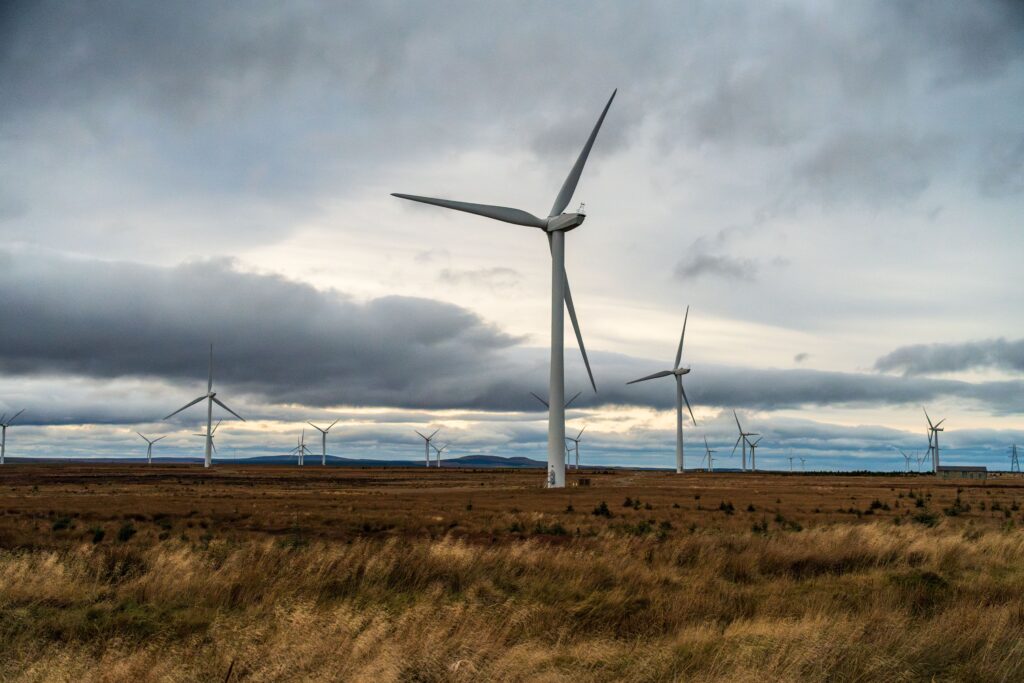
- Developers are calling for at least 30 GW of Scottish onshore wind by 2040.
- Industry-commissioned research estimates £4.2 billion of additional Scottish economic value.
- The proposal would extend investment visibility, but delivery depends on networks, planning and revenue arrangements.
Scottish onshore wind developers have urged ministers to adopt a target of at least 30 GW by 2040, arguing that a longer-term commitment would sustain investment and supply chain activity beyond the current decade.
Research by BiGGAR Economics, commissioned by the Scottish Onshore Wind Developers Forum, estimates that achieving the proposed ambition could add £4.2 billion in gross value added to Scotland’s economy.
The analysis also projects an average of 6,100 additional jobs during 2034-2040 across development, construction and operations. Scotland currently has about 10.4 GW of installed onshore wind, with up to 18.1 GW of projects currently in development or planning.
Forum chair Rosie Vetter warned that “the current low ambition after 2030 risks preventing the deployment” of a technology that could strengthen UK energy security.
The proposal has not been adopted as government policy. Scotland’s existing ambition remains 20 GW of onshore wind by 2030, while its climate plan sets out a separate ambition for up to 40 GW of new offshore wind capacity by 2040.
Route to market
The developers’ case concerns the period after 2030, when decisions taken now will influence the availability of new projects and replacement capacity.
According to Windtech International, forum members have more than 6 GW of Scottish projects in development. The publication reports that the proposed pathway includes repowering existing sites as well as developing new wind farms, and could generate additional community payments and business rates. These remain modelled benefits rather than committed investment or guaranteed public income.
A longer-term ambition could help businesses judge whether to recruit staff, expand facilities or maintain development teams. Those decisions become harder when the visible market ends before investments have had time to earn a return.
However, capacity targets alone do not establish the commercial conditions required to build. Projects also need viable electricity sales, affordable financing and a credible connection date. Planning approval alone cannot supply those conditions.
Earlier pipeline work commissioned by Scottish Renewables identified constraints including consenting resources, abnormal load transport, network connections and the scale of Contracts for Difference allocations. Although that analysis addressed the 2030 ambition, it demonstrates why a longer horizon must be accompanied by a practical delivery programme.
The economic estimates also need to be read in context. The commissioning body’s findings strengthen the case for examining the opportunity, but they do not settle questions about individual sites, network costs or the balance between generation technologies.
For UK consumers, the value of additional Scottish wind would depend partly on whether electricity can reach demand centres when it is produced. Transmission investment, storage and flexible demand therefore belong in the same planning discussion as generation capacity.
The issue is already part of the debate over Britain’s Strategic Spatial Energy Plan. In an August parliamentary answer, Scottish energy minister Stephen Gethins said the government was making the case for the plan to use Scotland’s renewable resources fully.
The next test is whether the proposed 2040 ambition is reflected in policy and supported by a deliverable pipeline. For developers and suppliers, that would provide a firmer basis for investment than a target standing alone.