
- First-half adjusted EBITDA fell from £460 million to £279 million, principally because of lower achieved power prices at Drax Power Station.
- Drax maintained full-year guidance of approximately £665 million and raised its 2029 target to between £650 million and £800 million.
- The £561 million acquisition of Bluefield Solar Income Fund would add 0.9 GW of operating renewables and a 2.9 GW development pipeline.
Drax has reported a 39% fall in H1 2026 earnings as weaker biomass power prices outweighed growth in energy services and the contribution from its first new gas peaking plant.
Adjusted earnings before interest, tax, depreciation and amortisation fell to £279 million from £460 million a year earlier, according to the group’s half-year results.
Biomass generation earnings more than halved from £332 million to £159 million, primarily because Drax realised lower forward power prices. Generation remained broadly stable at 7TWh.
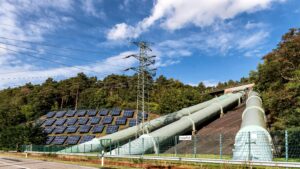
Pellet production EBITDA fell from £74 million to £64 million, while pumped-storage and hydro earnings declined from £64 million to £47 million. The latter result included planned and unplanned outages at the Cruachan pumped-storage plant.
Energy Solutions earnings increased from £18 million to £27 million. Hirwaun, the first of Drax’s new open-cycle gas turbines, began operating in May and contributed £4 million.
Despite the decline, Drax maintained full-year expectations in line with the analyst consensus of approximately £665 million. Net debt fell slightly to £1.03 billion, while the interim dividend increased from 11.6p to 12.9p a share.
“We are at a key moment in Drax’s transition, investing to create a larger and broader portfolio with more MWs under management that can provide more power to the country when needed,” said chief executive Will Gardiner.
“We are also actively developing options for more renewables, including the proposed acquisition of Bluefield Solar Income Fund, and our trading and optimisation platform… we believe that these actions can support energy security and will increase the group’s generation capacity by around 85% compared to 2025.”
The central part of that expansion is Drax’s proposed acquisition of Bluefield Solar Income Fund for £561 million, implying an enterprise value of approximately £1.08 billion.
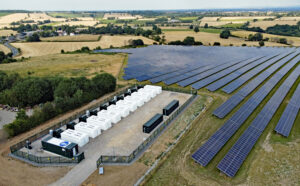
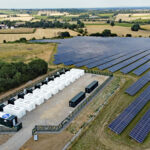
Bluefield owns around 0.9 GW of operating solar and wind assets. It also holds a 2.9 GW pipeline of solar and battery projects, including approximately 0.5 GW of solar capacity supported by contracts for difference lasting between 15 and 20 years.
Bluefield shareholders voted 99% in favour of the deal on 24 July. Completion was expected on 31 July following court approval and clearance under the UK’s national security investment regime.
Beyond biomass
Drax is separately developing 710 MW of battery capacity through physical projects and tolling agreements with Fidra and Zenobē. The projects are expected to enter service during 2027 and 2028.
The company expects its battery, biomass, flexible generation and pellet businesses to deliver adjusted EBITDA of between £650 million and £800 million in 2029, excluding any contribution from Bluefield.
It is also assessing how to use 4 GW of grid access at its Selby site. A planning application for an initial 100 MW data centre is due during the second half of this year.
The strategy represents a material shift from Drax’s dependence on biomass. Solar assets would supply long-term contracted earnings, while batteries, pumped storage, gas turbines and trading provide exposure to the growing value of flexibility.
That transition remains incomplete. Biomass was still responsible for more than half of group EBITDA before central costs during the first half, leaving earnings sensitive to power prices and public support.
Drax’s existing subsidy arrangements expire in March 2027. A new dispatchable contract for difference will support its four biomass units until 2031 at a strike price of £109.90/MWh in 2012 prices, but with generation limited to a 6TWh annual support collar.
Bluefield therefore provides operating assets at a strategically useful moment. Its development pipeline is less certain, since projects must still obtain planning consent, grid connections, contracts and finance.
The acquisition also pauses Drax’s share buyback programme and adds financing requirements. Its success will depend on converting pipeline capacity into cash generating assets without weakening the balance sheet.
Drax is becoming a broader flexible power company, but the transition will take time: biomass remains the bridge between its current earnings and the solar, battery and optimisation portfolio it intends to build.