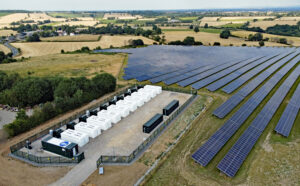

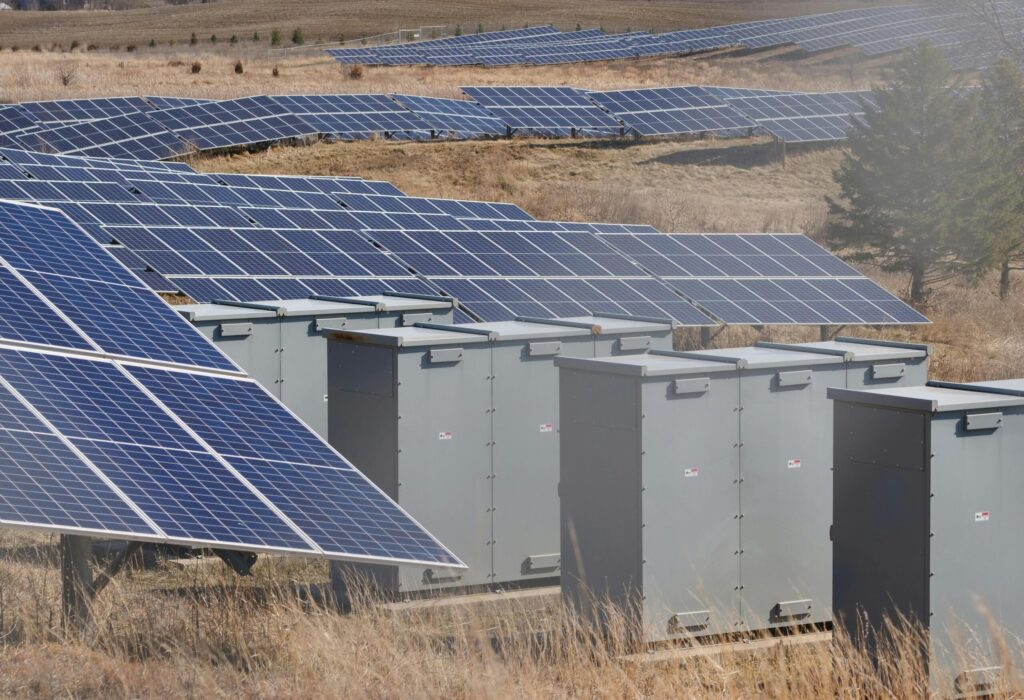
- Matrix Renewables has closed £245m financing for a 500MW/1GWh battery energy storage system (BESS) in Scotland – one of the UK’s largest battery projects to move into delivery phase.
- The project targets the congestion-heavy Anglo-Scottish border region.
- The announcement should help reinforce investor confidence in UK flexibility assets.
A major UK battery storage project has secured financing, marking another step forward in the build-out of large-scale flexibility infrastructure needed to support the energy transition.
Developer Matrix Renewables has closed £245m in non-recourse financing for its 500MW/1GWh Eccles-Leitholm battery energy storage system (BESS), located near the Scotland-England border, according to Renewables Now.
The project is among the largest standalone battery developments in the UK and is strategically positioned in a region characterised by high renewable generation and constrained transmission capacity. This makes it particularly valuable for managing excess wind output and reducing the need for costly curtailment.
Battery storage has moved rapidly up the policy and investment agenda as the UK seeks to decarbonise its power system while maintaining reliability. As intermittent renewable generation grows, the ability to store and dispatch electricity becomes critical to balancing supply and demand in real time.
The financing structure reflects growing confidence among lenders in the revenue potential of battery assets. Income is typically derived from multiple streams, including frequency response services, energy arbitrage and participation in capacity markets. Increasingly, however, investors are seeking more predictable returns through optimisation agreements and structured contracts.
The Eccles-Leitholm project also highlights the geographic dimension of the UK’s energy transition. Scotland’s abundant wind resources often exceed local demand, creating bottlenecks in transmitting power southwards. Large-scale storage located near these pinch points can help smooth flows across the system and reduce inefficiencies.
While the deal is a positive signal, it also underscores the scale of the challenge ahead. The UK will require many more projects of this size – and larger – to support a fully decarbonised grid. Questions remain around long-duration storage, revenue stability and market design.
For now, the key takeaway is that battery storage is no longer a peripheral technology. It is becoming a core component of the UK’s energy infrastructure, attracting significant capital and playing a central role in enabling the next phase of the transition.