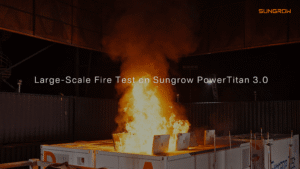

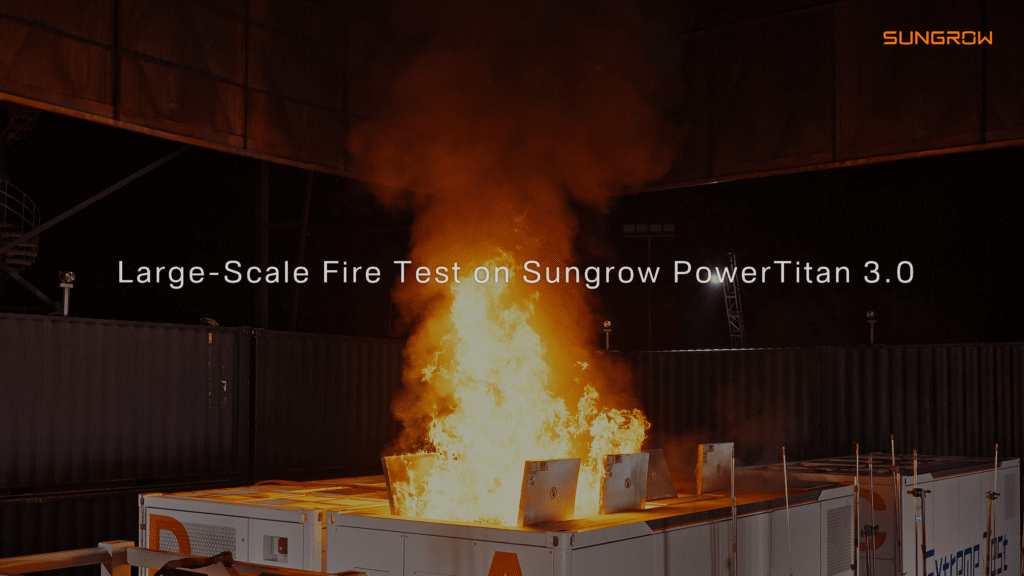
Sungrow’s PowerTitan 3.0 battery energy storage system contained a deliberately initiated thermal runaway event within one container during a large-scale fire test, with no propagation to adjacent containers or a medium-voltage substation, the company said.
The test involved 28.56MWh of battery storage and a 7.4MW medium-voltage substation in a layout representing a utility-scale installation. Monitoring continued for 7.5 hours, with the initiating container reaching a peak internal temperature of approximately 1,260°C.
Sungrow announced the results on 21 October 2026. UL Solutions conducted the test, Fire Risk Alliance witnessed it and Jensen Hughes attended as an observer.
According to Sungrow, the test followed the applicable requirements of UL 9540A: 2026 and CSA/ANSI C800-2025. The company also claimed PowerTitan 3.0 was the first stacked-cell battery system with an integrated AC-block design to complete such a test.
Suppression and cooling disabled during test
The batteries were tested at 100% state of charge. The initiating container and an adjacent container were positioned closely together, back-to-back, with the substation included in the configuration.
All active fire suppression and thermal management systems were disabled. Rooftop pressure-relief panels on the initiating container were fully opened to increase ventilation and oxygen availability.
The configuration tested the system’s ability to limit propagation without assistance from active suppression or cooling. It therefore assessed a specific fire scenario rather than the operation of all protective systems together.
PowerTitan 3.0 combines stacked battery cells and a DC/AC power converter within a single 20-foot container. Its integrated design places battery storage and power conversion equipment within the same enclosure.
The announcement did not specify the distance between containers or provide the complete test report.
Adjacent containers remained below thermal runaway threshold
Sungrow said the highest cell temperatures recorded in neighbouring containers remained below the thermal runaway threshold used in the test. It did not disclose those temperatures.
Thermal runaway occurs when a battery cell enters an uncontrolled, self-heating reaction. A central concern for large storage installations is whether an event in one enclosure can spread to neighbouring equipment.
The initiating container remained structurally intact, according to Sungrow. Four adjacent containers also retained their structural integrity without deformation. The company said the fire-affected container could subsequently be lifted as a complete unit.
These findings relate to containment and propagation under the tested conditions. They do not mean the initiating container avoided a severe internal fire or that its equipment remained operational.
Smoke and fire gases were collected and routed through a dedicated purification system. Sungrow said no untreated smoke was released directly into the environment during the test.
Physical results compared with simulations
Before the fire test, Sungrow assessed PowerTitan 3.0 through simulations covering hundreds of application scenarios and operating conditions.
The company said simulated fire intensity and development trends closely matched the physical event. It did not publish quantitative comparisons or prediction tolerances in the announcement.
Roger Li, general manager of Sungrow Energy Storage’s utility-scale product line, said safety depended on cell performance, system integration, thermal management, structural protection and engineering design working together.
Benjamin Liu, engineering manager at UL Solutions, said the test showed the design could contain the fire and prevent propagation, reducing the potential scale of loss.
Sungrow said all three PowerTitan generations had completed their respective large-scale fire tests on the first attempt.
For project developers and operators, the reported result provides evidence about separation between containers and protection of adjacent equipment in this configuration. Applying it to a particular site would require consideration of that installation’s layout, equipment and operating conditions, alongside the full test documentation.