
- Saudi Arabia has awarded four standalone battery projects totalling 2 GW of power and 8 GWh of energy capacity.
- Each 500 MW project will discharge at full output for four hours and operate under a 15-year storage services agreement.
- The most significant feature is the bankable procurement model, which treats storage as a contracted system service rather than a purely merchant investment.
Saudi Arabia has signed agreements for four battery storage projects with a combined investment of more than SAR4.35bn, equivalent to about $1.16bn, as the Kingdom looks to build large-scale flexibility alongside its expanding renewable generation fleet.
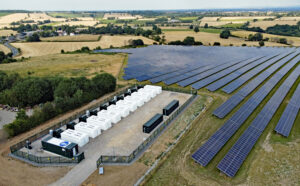
The four projects will each provide 500 MW of power and 2,000 MWh of energy storage, giving a combined portfolio of 2 GW / 8 GWh. At full output, each facility will be capable of discharging for four hours.
Three projects, at Haden, Muwayh and AlKahfah, will be developed by a consortium comprising Saudi Energy, ACWA Power and Al Sharif Contracting. The fourth, Al Khushaybi, was awarded to a consortium led by Engie and Haji Abdullah Alireza & Co, according to reports.
Saudi Power Procurement Company will act as principal buyer. The developers will finance, construct, own and operate the assets under a build-own-operate structure, receiving revenues through 15-year Storage Services Agreements.
The arrangement implements the structure SPPC established when it launched qualification for the initial procurement in November 2024. The Saudi Press Agency notice specified four projects totalling 2 GW with four-hour duration and a 15-year contract for each special-purpose company.
ACWA confirmed that its three projects account for 1.5 GW / 6 GWh of the total and that the agreements were signed on 20 August. “These plants will hold energy generated through the day and release it when demand reaches its peak,” Saudi chief executive Omar Al Hassan said.
The procurement model
The distinction between power and energy is essential. The portfolio can inject a maximum of 2 GW into the grid, while its 8 GWh energy capacity determines how long it can sustain that output. It is therefore designed principally to move substantial volumes of daytime generation into the evening peak while also providing fast-response grid services.
Storage does not create electricity and cannot compensate indefinitely for a prolonged supply shortage. Its value depends on access to low-cost charging energy, adequate network capacity and dispatch rules that reward flexibility. In Saudi Arabia, abundant daytime solar generation makes the four-hour configuration particularly useful.
The 15-year contracts address a different problem: revenue certainty. Developers in many electricity markets must combine volatile income from wholesale price arbitrage, frequency response, balancing services and capacity payments. A long-term agreement with a central, government-backed buyer can reduce financing risk and permit more aggressive pricing.
That makes the Saudi model relevant beyond the Gulf. SPPC is procuring storage as an independent service, rather than treating batteries as an optional addition to individual solar projects. Standardised 500 MW / 2,000 MWh blocks can also simplify tendering, engineering and equipment purchasing.
The first awards are already becoming a programme rather than a one-off transaction. SPPC has qualified 27 applicants for a second group comprising six further 500 MW / 2,000 MWh projects, or another 3 GW / 12 GWh.
The UK has succeeded in attracting capital through multiple revenue streams, but increasing capacity can reduce the value of the very balancing services on which early projects depended. Saudi Arabia is instead purchasing availability and operational capability for 15 years.
Its centralised model cannot be imported directly into Britain’s liberalised market. It does, however, demonstrate how long-term system service contracts can make storage bankable at scale. As battery fleets grow, policymakers will increasingly have to decide which flexibility services should remain merchant and which are important enough to procure explicitly.