Solar generated 3.2 TWh during July, raising its share of the UK’s electricity mix from 9.6% a year earlier to a record 14.4%.
Exceptional weather made a major contribution, with the UK recording its sunniest July since comparable records began in 1910.
The record strengthens the case for solar deployment, but also increases the need for batteries and flexible demand capable of absorbing abundant midday power.
Solar supplied a record 14.4% of the UK’s electricity during July as exceptional sunshine combined with continued growth in rooftop and utility-scale generating capacity.
The monthly share surpassed the previous record of 12.4%, set in May, and was 50% higher than the 9.6% recorded in July 2025. Solar farms and rooftop systems generated approximately 3.2 TWh over the month, according to National Energy System Operator (NESO) data published by Solar Energy UK.
Solar met 18.8% of electricity generation across the day on 12 July. Its share reached 44% between 10.30 am and midday, when output peaked at 15,427 MW.
The record partly reflected unusually favourable weather rather than capacity growth alone. Provisional Met Office figures show the UK received 258.7 hours of sunshine, 49% above the 1991-2020 average and the highest July total in a series dating back to 1910. England and Wales both experienced their sunniest calendar month on record.
Energy minister Michael Shanks said the figures demonstrated that Britain’s solar sector was continuing “to go from strength to strength”.
“After two fossil fuel crises in five years, the lesson is clear: the more power we generate here in Britain, the less exposed families and businesses are to global energy price shocks,” he said.
The weather effect was reinforced by a sharp increase in deployment. Official UK statistics recorded 142,536 new solar installations during the first half of 2026, taking the total above 2.07 million. That was the strongest six-month installation total since the second half of 2011, when 167,316 systems were installed during the feed-in tariff boom.
Most of this year’s installations were household rooftop systems. E.ON Next reported a 151% year-on-year increase in its own residential installations during the first half, while Octopus Energy said solar sales rose by more than 54% in March as renewed conflict in the Middle East drove fossil fuel prices higher.
“People want to engage with their energy use, take control of their bills and rely less on the grid,” said Phil Gilbert, E.ON Next’s director of net zero delivery. “The real opportunity now is making sure every household gets full value from what their panels produce, not just using it, but storing and selling it too.”
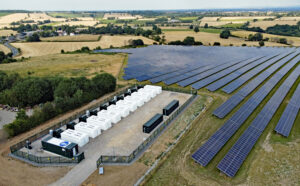
Utility-scale additions are also becoming more significant. The 373 MW Cleve Hill development in Kent became Britain’s largest operating solar farm after reaching full output in 2025, while several projects of 500 MW or more are progressing through development and construction.
The government’s Clean Power 2030 plan calls for 45-47 GW of installed solar capacity by the end of the decade, compared with 16.6 GW in 2024. Rooftop deployment outside the main transmission-connections process could potentially lift the total to 54-57 GW.
Reaching those levels will change the measure of success. Higher generation reduces exposure to gas during sunny periods and can help meet additional summer demand, but it also concentrates output around the middle of the day. Without sufficient storage, flexible consumption and network capacity, more solar will depress its own wholesale value and create periods of surplus generation.
Home and grid-scale batteries can shift some output into the evening, while smart charging, heat pumps and commercial demand can consume electricity when it is abundant. Distribution networks will also need better visibility of systems that sit below transmission level.
The 14.4% figure itself is an operational estimate rather than a complete metered census. Much of Britain’s solar capacity is embedded in distribution networks and therefore appears to NESO as reduced demand. The system operator models its output using installed capacity and solar radiation, while some transmission-connected solar is still classified within its “other” generation category.
July’s result nevertheless shows that solar is becoming a material component of Britain’s power system. The next challenge is ensuring that its increasingly abundant daytime output remains commercially valuable and useful after the sun goes down.