

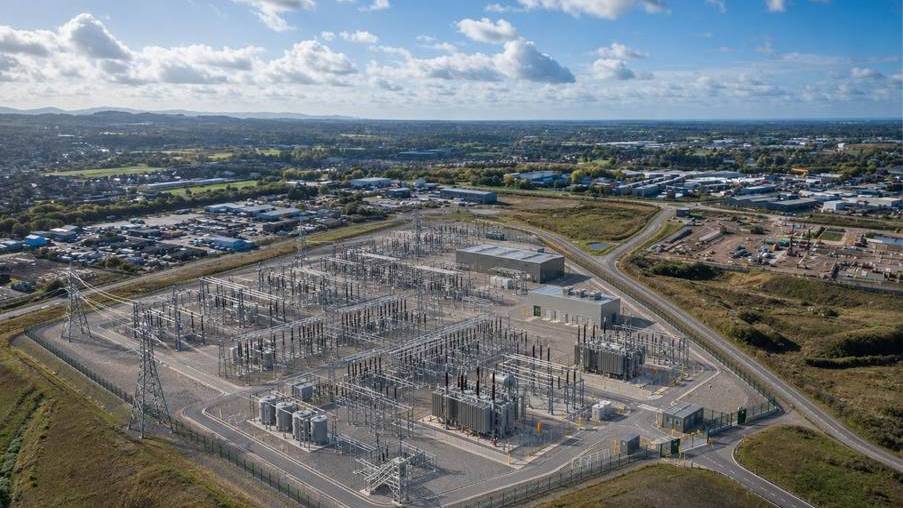
- National Grid has agreed to buy more than 70 acres for a proposed substation serving development at Teesworks.
- Company documents support a connection driven by credible customer demand, while a larger 3.2 GW figure remains a separate claim about the site’s potential.
- The opportunity for energy businesses depends on confirmed investment, planning decisions and the delivery of usable electricity capacity.
National Grid Electricity Transmission has agreed a land purchase at Teesworks that could advance a major electricity connection for a neighbouring AI data centre development, giving Teesside a stronger position in the competition for power-intensive investment.
The agreement covers 73.3 acres at Dorman Point on the former steelworks estate, although the purchase price was not disclosed.
Sky News reported interest from US technology companies and said a preferred investment partner could be selected in the coming months. Those details were attributed to industry sources, with no data centre operator formally named in the report.
National Grid’s October needs-case document describes Tees Dock as a proposed 400kV substation responding to customer connection requests. It would initially connect through the existing Lackenby-Norton overhead line.
The document identifies a customer with a Gate 2 Phase 1 connection under the reformed connections process as the principal driver. It also makes clear that the company is seeking Ofgem’s approval of the needs case and preferred design.
“Securing this land agreement is an important step forward in the development of the new substation,” said National Grid head of land Matt Pearce.
“It reflects the constructive work between all those involved to enable this vital infrastructure which is part of The Great Grid Upgrade, the largest upgrade of the electricity grid in generations, and will support the growth of AI and digital technologies and enable the region’s next phase of industrial and economic development.”
Local reporting puts the substation’s contracted import and export capacity above 1 GW. Tees Valley mayor Ben Houchen has separately referred to potential capacity of up to 3.2 GW at the site. The figures should not be treated as interchangeable.
Grid access shapes investment
The project illustrates how the availability of electricity infrastructure can determine whether a development site attracts industrial capital – land and planning permission for buildings have limited commercial value to a data centre operator without a deliverable power connection.
National Grid’s preferred design also reveals the practical constraints behind that connection. Its assessment favours an indoor gas-insulated substation using equipment without SF6, a powerful greenhouse gas traditionally used in switchgear.
The company says the compact design fits the land available for voluntary purchase and avoids the delay associated with seeking a larger site. An alternative air-insulated design had lower estimated costs, but scored less well on deliverability. The decision therefore balances equipment expenditure against the prospect of meeting connection dates.
For UK renewable developers, substantial new demand could create opportunities for power purchase agreements and flexibility services. However, the announcement does not establish the eventual electricity procurement strategy, the development’s operating profile or the amount of additional generation that will be required.
Nor does securing a substation site establish that power can be supplied without wider system costs. The commercial assessment must consider the surrounding network, connection arrangements and the extent to which demand can respond when the system is under pressure.
The campus and its electricity infrastructure also sit at different stages of approval. Review North reports that the data centre development already has planning permission, while the substation’s outline application remains undecided.
That distinction will shape the next phase. Investors need a coordinated programme covering remediation, network construction and customer facilities, with responsibilities and delivery dates that align. Until those elements are secured, Teesside has advanced a significant infrastructure opportunity, but the scale and timing of the resulting investment remain to be demonstrated.