

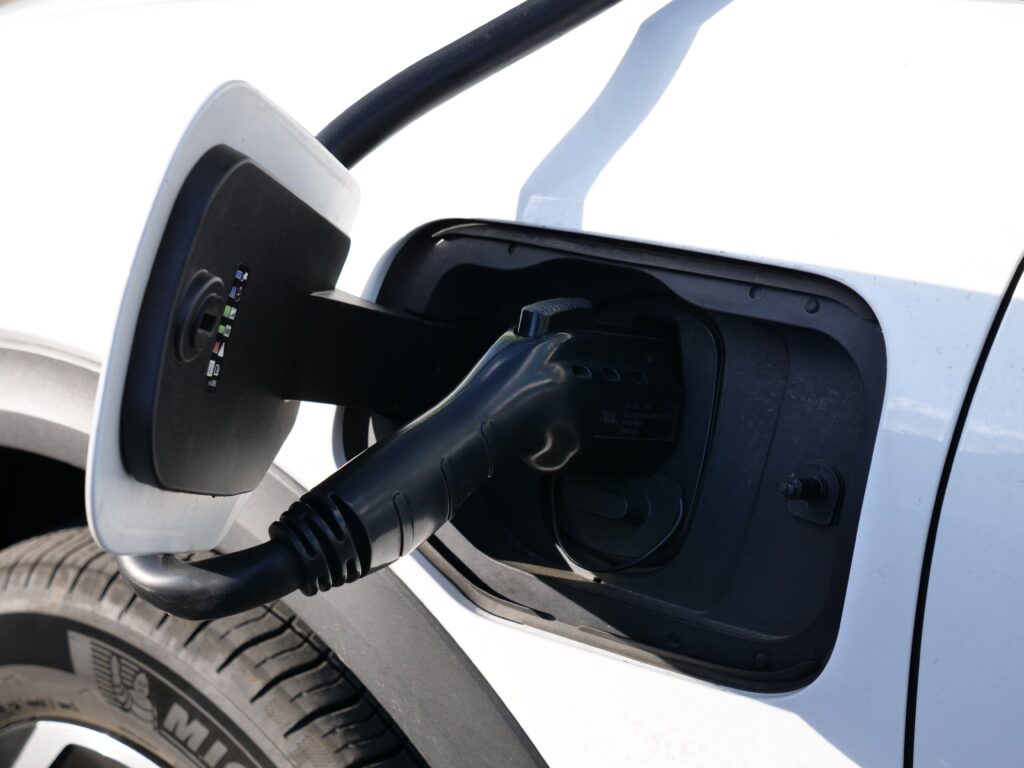
- The government is consulting on reducing the 2030 zero-emission car target from 80% to 70%, 60% or 50%, with equivalent cuts proposed for vans.
- The 2035 requirement for all new cars and vans to be zero emission remains unchanged, potentially leaving a much steeper transition after 2030.
- Government modelling shows the weakest option could remove 8.4 million tonnes of annual carbon savings during the sixth carbon budget period.
The UK government has opened a review of its Zero Emission Vehicle Mandate that could substantially reduce the number of electric cars and vans manufacturers must sell by 2030, reopening one of the country’s most important transport decarbonisation policies.
The current mandate requires zero-emission vehicles to account for 33% of new car sales and 24% of van sales in 2026, rising to 80% and 70% respectively by 2030.
Under options set out by the Department for Transport, the 2030 car target could instead be reduced to 70%, 60% or 50%. For vans, the equivalent alternatives are 60%, 50% or 40%.
A fourth option would retain the existing 80% car and 70% van targets but extend compliance flexibilities, including credit banking, borrowing and transfers between the mandate and manufacturers’ separate emissions obligations. These mechanisms are currently due to expire in 2029.
The consultation, which closes on 23 October, maintains the government’s commitment to phase out new cars relying solely on petrol or diesel engines in 2030 and require all new cars and vans to be fully zero emission by 2035. The full consultation document acknowledges that reducing the earlier targets would require faster adoption between 2030 and 2035.
Business, Innovation, Science and Trade Secretary Jonathan Reynolds said the government would examine the evidence to ensure the mandate continued to support “investment, innovation and competitiveness”.
The review follows sustained pressure from vehicle manufacturers, which argue that consumer demand has not kept pace with their regulatory obligations.
Battery-electric cars accounted for around 27.5% of registrations in July after volumes increased by 44.5% year on year. However, the Society of Motor Manufacturers and Traders expects their full-year share to reach only 27.4%, below the 33% headline mandate target. Manufacturers can nevertheless use existing flexibilities to bridge part of that gap.
Mike Hawes, chief executive of the SMMT, said regulatory targets were “running ahead of current consumer demand”. He argued that the mandate was designed when energy was cheaper, production costs were expected to fall faster and forecasts for global EV demand were more optimistic. The SMMT welcomed the review but called for a rapid decision.
Charging and investment groups have taken the opposite view. James Alexander, chief executive of the UK Sustainable Investment and Finance Association, warned that the review would “heighten the risks for investment” in charging infrastructure by weakening the predictable growth trajectory on which private capital depends. UKSIF’s response reflects the concern that policy uncertainty could affect infrastructure before any target is formally changed.
Adoption uncertain
The government’s own carbon analysis illustrates the scale of the trade-off. Reducing the 2030 targets to 50% for cars and 40% for vans, while extending flexibilities, would cut expected emissions savings by an average of 8.4 million tonnes of CO2 equivalent a year during the sixth carbon budget period. That represents 6% of the economy-wide savings expected under the government’s Carbon Budget and Growth Delivery Plan.
The 70% car and 60% van option would remove 3.2 million tonnes of annual savings, while retaining the current targets with longer flexibilities would have a considerably smaller effect of around 500,000 tonnes.
The strategic risk is that weakening the mandate could solve an immediate commercial problem by creating a more difficult one later. Manufacturers would face less pressure to sell EVs before 2030, but would then need to move from a potentially much lower base to 100% in five years.
It would also affect businesses whose investment depends on the vehicle trajectory rather than the 2035 end point alone. Charging operators, fleet companies and electricity networks make long-term capital decisions based on the expected pace and location of EV adoption.
The consultation does not amount to a policy reversal yet. However, the breadth of the options suggests that significant changes are genuinely under consideration. The final decision, expected as part of the mandate review by early 2027, will determine whether the government continues to use regulation to pull consumer demand forward or shifts more responsibility to grants, tax incentives and market forces.