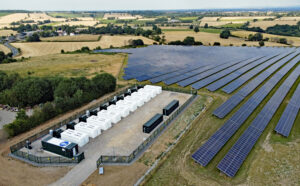

- Wärtsilä and German engineering company RCT Solutions have launched Valo as a 50:50 utility-scale battery storage joint venture, transferring Wärtsilä’s existing Energy Storage business into the new company.
- Valo starts with more than 20 GWh across over 130 projects, but that track record is inherited principally from Wärtsilä rather than representing new orders secured by the venture.
- Its launch comes as Chinese companies rapidly increase their dominance of the global storage integration market, putting pressure on Western suppliers to compete on software, system integration, supply chain resilience and long-term support rather than hardware price alone.
Wärtsilä and German engineering group RCT Solutions have launched a new battery energy storage company with more than 20 GWh of projects already delivered or contracted, as Western system integrators face intensifying competition in one of the fastest-growing parts of the power market.
Valo, jointly owned by the two companies, will combine Wärtsilä’s existing global Energy Storage business with RCT’s engineering, manufacturing and supply-chain capabilities.
The company begins operations with more than 130 utility-scale projects worldwide and activities spanning Europe, Australia, Asia and the Americas.
Its offering brings together battery hardware, control and optimisation software, engineering and lifecycle services, positioning Valo as a full system integrator rather than a battery manufacturer.
Luke Witmer, Valo’s chief technology officer, said increasingly complex projects required greater accountability from integrators rather than customers managing multiple separate suppliers.
“The performance of an energy storage project depends on how effectively every element of the system is managed altogether,” he said. “Integration defines outcomes.”
The launch completes a transaction first announced in June, when Wärtsilä agreed to move its storage operation into a 50:50 venture with RCT. Around 450 employees transfer into the new business.
Scale from launch
The 20 GWh starting portfolio gives Valo unusual scale for a newly created company, but it largely reflects Wärtsilä’s established position in battery storage.
Its Energy Storage division generated €694m of net sales in 2025, equivalent to around 10% of Wärtsilä’s group revenue, and ended the year with an order book of €719m.
Projects include some of the largest and most technically demanding batteries in markets such as Britain, Australia and the US.
In the UK, Wärtsilä supplied Zenobē’s Blackhillock project in Scotland, which combines large-scale battery storage with grid-forming technology designed to provide inertia and other stability services traditionally supplied by synchronous fossil-fuel generation. Wärtsilä has pointed to such projects as evidence that system value increasingly depends on sophisticated control software rather than battery cells alone.
That software heritage is likely to remain a central differentiator for Valo. Wärtsilä’s storage portfolio incorporates its GEMS digital energy management platform, which coordinates batteries and other power assets and can respond to changing grid conditions and market signals.
Valo chief executive Peter Fath said the company intended to compete on performance over the entire asset life rather than simply supply equipment.
“We will raise the standard for how energy storage systems are designed, delivered and supported throughout their lifetime,” he said.
Profitability remains a challenge
The restructuring also reflects the increasingly difficult economics facing storage integrators.
Wärtsilä’s Energy Storage business produced an operating result of just €23m in 2025, equivalent to a 3.3% margin, compared with a 12.1% operating margin across Wärtsilä as a whole.
The company cited lower volumes, US tariffs, changing Foreign Entity of Concern rules and increasing international competition as headwinds during 2025. Energy Storage order intake weakened during much of the year before recovering in the final quarter.
Conditions deteriorated further in early 2026. By the end of the second quarter, the storage order book had fallen to €545m from €800m a year earlier, while the discontinued business recorded a €7m loss for the quarter.
Wärtsilä expects Valo to report an operating loss in 2026 before moving to positive results towards the end of 2027. It also recognised a write-down of capitalised storage R&D ahead of completing the transaction.
Creating a separately managed joint venture therefore gives the storage operation greater freedom to adjust its manufacturing and supply chain while allowing Wärtsilä to concentrate more heavily on its higher-margin marine and engine power businesses.
New investors could also be introduced at a later stage, potentially diluting the current 50:50 holdings of Wärtsilä and RCT.