

- New statutory guidance asks Ofgem to give greater weight to domestic capability, jobs, skills and supply chain resilience when regulating network investment.
- Network procurements should retain at least a 10% social value weighting and work towards 20%, but the policy is not a mandatory UK content rule.
- Its impact will depend on Ofgem’s implementation and whether manufacturers receive sufficiently clear, long-term demand signals to invest.
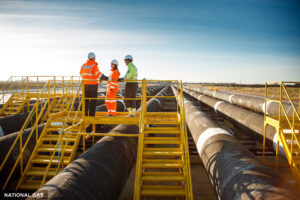
The UK government has instructed the energy regulator to treat the country’s record programme of grid investment as an opportunity to build domestic industrial capacity, rather than solely as a construction challenge.
Revised strategic growth guidance was laid before parliament on Monday and is expected to take effect on 17 November under section 3B of the Electricity Act. It asks the Gas and Electricity Markets Authority, Ofgem’s governing body, to consider how regulation can support UK manufacturing, regional employment, skills and more resilient supply chains.
The scale of spending makes the intervention significant: the government estimates that the UK must build approximately four times as much new transmission infrastructure between 2024 and 2030 as it constructed in the entire period since 1990.
“It is imperative that we harness the opportunity afforded by the energy transition,” the guidance’s ministerial foreword says, including by incentivising more manufacturing in the UK.
Ofgem must now consider procurement approaches that strengthen domestic capability and supply chain resilience while preserving value for billpayers. It is also expected to develop clearer growth metrics, encourage regional reporting by transmission and distribution companies, and publish an annual account of how it has implemented the guidance.
Not a local content mandate
The guidance maintains an expectation that network tenders apply a minimum 10% social value weighting and asks Ofgem and network owners to consider how this might rise towards 20%. However, the government’s new procurement policy note requiring 20% social value weightings for certain public contracts does not automatically cover private network utilities.
Nor does the guidance require equipment to be manufactured in the UK. The government explicitly says it is not imposing a local content rule, which could conflict with non-discrimination and international trade obligations. Instead, bidders can receive credit for outcomes such as UK jobs, skills, final assembly, investment in constrained upstream supply chains and regional economic benefits.
That distinction leaves Ofgem responsible for translating ministerial intent into an evidence-based regulatory framework. In its own March call for evidence, the regulator said transmission owners could invest more than £70bn between 2026 and 2031, with electricity demand potentially doubling by 2050. It acknowledged that a domestically produced component may carry a higher upfront price while still offering longer-term consumer value through shorter lead times and greater resilience.
The consultation exposed considerable implementation anxiety. Of 30 responses, 22 supported the overall direction. But 22 also requested clearer definitions, methodologies or reporting rules, while only one of the 22 responses assessed on ease of implementation was categorised as supportive.
Respondents warned of higher bills, procurement disputes, administrative burdens and gaming of loosely defined “British” value. They also stressed that regulation cannot by itself solve shortages of skilled labour, transformers, cables, industrial sites or affordable electricity.
The government responded by confirming that Ofgem’s consumer protection and environmental duties remain fully intact. It also asked the regulator to explain how it will manage trade-offs and to ensure that reporting requirements do not become barriers to new entrants.
For equipment suppliers, the policy’s real value will be measured in demand visibility. A scoring adjustment in one tender is unlikely to justify a new factory; a transparent, standardised pipeline of orders across several price control periods might.
This is therefore best read as the start of a new regulatory settlement: network investment is being treated as industrial strategy. Whether it produces factories rather than paperwork will depend on the procurement rules Ofgem now develops.