
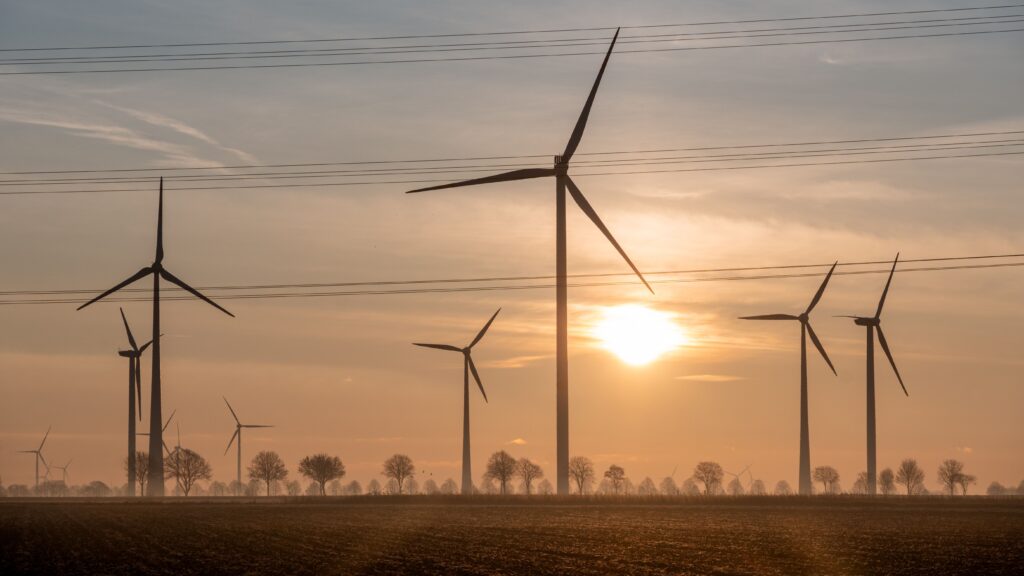
- Europe installed 8.8 GW of wind capacity in the first half of 2026, 30% more than a year earlier, with the UK ranked second behind Germany.
- The installation rebound masks a weaker forward pipeline: capital raised for new projects fell from €34bn in the first half of 2025 to €9bn this year.
- The UK’s 789 MW of additions demonstrate delivery strength, but falling permitting volumes threaten the projects needed later in the decade.
Europe is heading for a record year of wind construction after installing 8.8 GW in the first six months of 2026, but declining investment and turbine orders suggest the momentum could prove difficult to sustain.
The first-half total was 30% higher than in the equivalent period of 2025. Germany accounted for 3.4 GW, or 39% of the continent’s additions, followed by the UK with 789 MW and Spain with 612 MW.
Onshore projects supplied 6.5 GW, or 74% of new capacity. A further 2.3 GW of offshore wind was connected across nine projects, approximately three times the first-half 2025 total, according to WindEurope’s autumn market report.
Europe now has more than 311 GW of wind capacity, comprising 270.5 GW onshore and 40.9 GW offshore. WindEurope expects 24 GW to be installed during 2026, which would make this a record year.
Chief executive Tinne Van der Straeten nevertheless warned that decisions on “permitting, auctions, grids and electrification” would make or break the current momentum. WindEurope said permitting volumes had fallen in the UK, Spain, France, Italy and Ireland, with Germany the notable exception.
Financing slowdown
The key indicator is not the 8.8 GW already installed, which largely reflects financing and contracting decisions made several years ago – it is the amount of capital being committed to the next generation of projects.
European wind developments raised just €9bn during the first half, financing 5.2 GW of future capacity. That compares with €34bn and 14 GW during the same period of 2025. The decline is particularly pronounced offshore: only 0.6 GW of the newly financed capacity was at sea.
Firm turbine orders also fell 12% to 10.6 GW. The juxtaposition is stark. Europe is commissioning more wind farms because an earlier investment cycle is reaching completion, while the financial commitments required to sustain that rate are weakening.
There is some countervailing evidence. Five countries awarded support to 17.2 GW during the first half and governments plan to auction more than 24 GW in the remainder of 2026 – yet auction awards only become operating projects if strike prices, grid connections and permitting conditions allow developers to reach final investment decisions.
WindEurope forecasts that the EU will reach 342 GW by 2030, providing about 27% of its electricity. That is around 83 GW below the estimated 425 GW required to support the bloc’s 42.5% renewable energy target. Its average forecast of 22 GW of EU additions a year also remains below the roughly 30 GW annual deployment rate the industry considers necessary.
For the UK, second place in the installation table is encouraging but should not be mistaken for pipeline health. The country’s additions reflect its mature offshore industry and projects already under construction. Reduced permitting activity, grid constraints and recurring tension over offshore wind economics affect what can be delivered after the present construction wave.
The wider European picture reinforces the same trend. Financing, orders and permits are the forward indicators, and all three determine whether manufacturing investment and supply-chain capacity remain in Europe.
The continent is therefore entering a potentially awkward phase: its strongest construction year may coincide with a deterioration in the conditions for the projects meant to follow it. Governments can close that gap through investable auctions, faster grid delivery and predictable permitting. Without those measures, 2026 could become a high-water mark rather than the beginning of the sustained acceleration Europe needs.