
- INEOS, Harbour Energy and Denmark’s Nordsøfonden have started commercial operations at Greensand, capable of storing up to 400,000 tonnes of CO₂ a year beneath the Danish North Sea.
- The initial operation will largely store biogenic CO₂ from Danish biomethane plants rather than emissions captured from heavy industry, with industrial volumes expected as the market develops.
- Greensand could eventually expand to between 4m and 8m tonnes a year, but that depends on capture projects, customer demand, infrastructure and regulation progressing in parallel.
Europe’s first full-scale commercial carbon capture and storage (CCS) operation has opened in Denmark, marking a significant step in efforts to develop a cross-border market for transporting and permanently storing industrial CO₂.
King Frederik X of Denmark officially inaugurated Greensand at the Port of Esbjerg on Friday, moving the project from demonstration into commercial operation after more than three years of testing and development.
Led by INEOS Energy alongside Harbour Energy and Danish state company Nordsøfonden, the first phase is designed to transport and permanently store up to 400,000 tonnes of CO₂ each year in the depleted Nini West oil reservoir, around 250 kilometres offshore and 1,800 metres beneath the seabed.
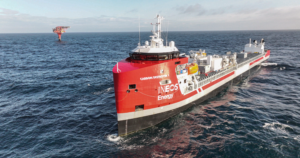
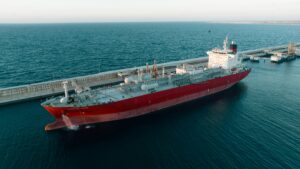
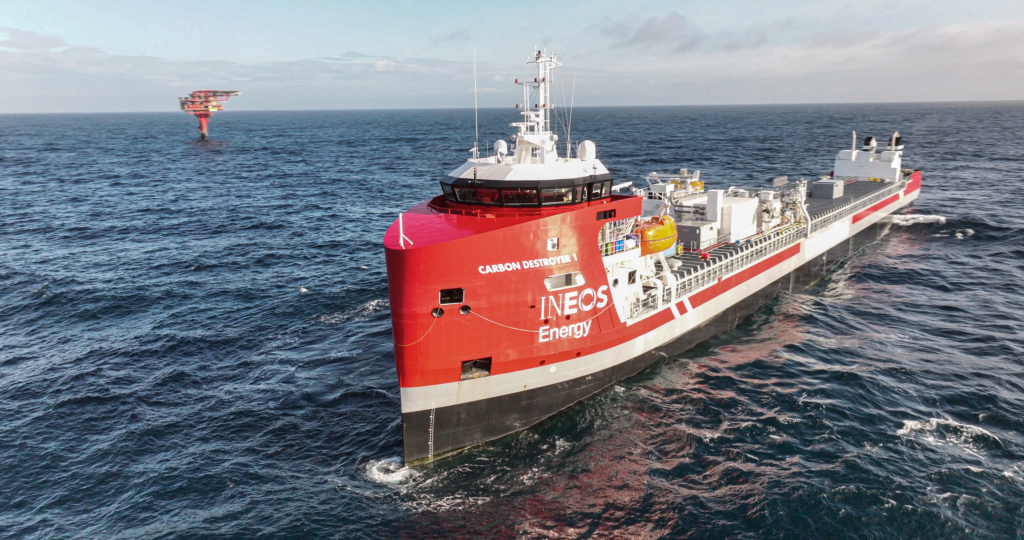
CO₂ will initially come primarily from Danish biomethane facilities. The gas is liquefied and transported by road to a terminal at Esbjerg before being shipped offshore aboard the dedicated Carbon Destroyer 1 vessel for injection.
Greensand’s launch represents an early test of whether Europe can turn a growing portfolio of CO₂ storage projects into the cross-border market needed to reach the EU’s 50m tonne annual injection capacity objective by 2030.
INEOS chairman Sir Jim Ratcliffe said the opening demonstrated how CCS could support industrial decarbonisation without requiring manufacturing capacity to leave Europe.
“Europe will not achieve net zero by closing factories and exporting its jobs,” he said. “We need solutions that allow industry to remain competitive while reducing emissions. Greensand proves it can be done.”
“The technology works. The storage is ready. The challenge now is creating the right conditions for carbon capture to grow quickly at scale across Europe.”
From pilot to commercial storage
Greensand builds on an earlier pilot that injected around 12,000 tonnes of CO₂ into the Danish North Sea in 2023.
That programme was notable for demonstrating the complete cross-border chain, with CO₂ captured at INEOS’s facility in Belgium before being transported to Denmark for permanent offshore storage. The operation required Denmark and Belgium to establish arrangements allowing international movement of CO₂ for geological storage.
The partners subsequently took a final investment decision on the commercial phase in December 2024. Harbour, which holds a 40% non-operated interest alongside INEOS’s 40% and Nordsøfonden’s 20%, described the project as a relatively short-cycle development benefiting from the reuse of existing North Sea infrastructure. The partners said at FID that investment across the initial Greensand value chain would exceed $150m.
That reuse is important to the economics. Instead of developing an entirely new offshore storage complex, Greensand converts infrastructure associated with the depleted Nini field, applying geological and engineering expertise originally developed for oil and gas production.
David Bucknall, chief executive of INEOS Energy, said the opening moved European CCS beyond the planning stage.
“For years, CCS in Europe has been defined by plans, targets and ambitions,” he said. “Today, Greensand brings the EU’s first full-scale CO₂ storage site and value chain into operation.”
Italy’s Ravenna CCS project has been permanently injecting CO₂ since 2024, but its first phase handles only around 25,000 tonnes annually. Greensand says its 400,000-tonne capacity makes it the first operational EU storage project above the 100,000-tonne threshold associated with the full requirements of the EU CCS Directive.
Outside the EU, Norway’s Northern Lights development began storing CO₂ in August 2025 and is already developing a larger European transport and storage business.
Biogenic CO₂ starting volumes
The source of Greensand’s first commercial volumes is significant. Rather than immediately receiving large quantities from cement, chemicals or other hard-to-abate industrial plants, the project is initially using CO₂ separated from biomethane production.
Biogas facilities offer relatively concentrated and accessible streams of CO₂, giving Greensand enough material to establish the logistics and storage chain while more complicated industrial capture projects are developed.
If biogenic CO₂ originally absorbed from the atmosphere is captured and permanently stored, the process can also amount to a carbon removal, subject to the sustainability of the biomass and accounting methodology.
INEOS estimates there could be around 21m tonnes a year of potentially capturable biogenic CO₂ associated with European biogas production. Later phases of Greensand are intended to handle both biogenic and fossil-derived industrial CO₂.
That means Friday’s opening establishes storage infrastructure, but it does not yet prove that Europe has solved the more difficult economics of capturing emissions from energy-intensive factories.
Capture is frequently the most expensive part of the CCS chain, particularly where CO₂ concentrations are low, while emitters also require sufficient carbon price exposure, subsidies or long-term contracts to justify investment.
Steep scale-up challenge
The disparity between Greensand’s starting capacity and Europe’s wider requirements illustrates the scale of the challenge.
The EU’s Net-Zero Industry Act sets an objective of at least 50m tonnes of annual CO₂ injection capacity by 2030, with specified oil and gas producers required to contribute towards developing storage.
Greensand’s initial 400,000 tonnes therefore represents less than 1% of the 2030 requirement.
Its longer-term potential is considerably larger. The partners believe the Danish storage complex could eventually handle between 4m and 8m tonnes annually, although they explicitly make that expansion dependent on customer demand, additional infrastructure, regulatory conditions and sufficient volumes being captured elsewhere in Europe.
The European Commission estimates that around 250m tonnes of CO₂ could need permanent storage annually by 2040 if the bloc is to follow its proposed pathway towards a 90% reduction in net greenhouse gas emissions. Its wider modelling envisages around 280m tonnes of annual CO₂ capture by then. Those are planning estimates rather than equivalent statutory targets to the 50m tonne 2030 injection capacity requirement.
Energy Commissioner Dan Jørgensen said Greensand demonstrated that Europe could move “from demonstration to deployment”, while allowing industrial production and employment to remain on the continent.
The question is now whether capture capacity can catch up with storage.
Storage pipeline takes shape
Greensand will not remain alone for long if Europe’s planned projects stay on schedule.
The Porthos project in Rotterdam is under construction and is intended to store around 2.5m tonnes annually from industrial facilities in the port area, although its start-up has slipped to the second half of 2027.
Eni and Snam meanwhile plan to expand Ravenna from its 25,000 tonne demonstration phase to around 4m tonnes of annual transport and storage capacity by 2030, with further expansion potentially taking the Italian hub to 16m tonnes.
That pipeline shifts the next bottleneck towards capture, transport infrastructure and commercial agreements linking emitters with available reservoirs.
Ship-based projects such as Greensand have an advantage because they can theoretically collect CO₂ from multiple countries without waiting for an interconnected European pipeline network. Over time, however, the European Commission expects regional pipeline and shipping systems to develop into a broader cross-border transport network.
INEOS Energy Europe chief executive Mads Gade said the ambition was to use Greensand as the basis for that emerging market.
“Greensand starts with biogenic CO₂, but its significance reaches far beyond that first step,” he said. “We are ready to expand capacity to receive CO₂ from industries across Europe.”
That is the more consequential test following Friday’s opening. Greensand demonstrates that captured CO₂ can be aggregated, shipped offshore and stored commercially in a depleted North Sea reservoir. Europe must now demonstrate that enough industrial capture projects can be financed and built to fill the storage capacity it is racing to develop.
If that happens, depleted North Sea oil and gas fields could acquire a second economic life as part of a European carbon management industry. If capture continues to lag, the risk is that storage infrastructure develops more quickly than the customers needed to use it.