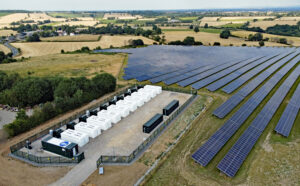

- Swiss developer BW ESS has broken ground on the Klostermansfeld battery energy storage project in Saxony‑Anhalt, Germany, boasting 1 GW of power and up to 5.7 GWh of storage – Europe’s largest BESS to enter construction.
- The facility, located near the Klostermansfeld substation, can supply around 3 million households for at least four hours and will begin commercial operations in 2028.
- Germany’s battery market is expanding rapidly; 2.25 GW (5.1 GWh) of storage capacity was commissioned in the first half of 2026, and large‑scale batteries help smooth prices and replace fossil peaking plants.
Swiss developer BW ESS has broken ground on the Klostermansfeld battery energy storage system in Saxony‑Anhalt, Germany – an enormous 1 GW/5.7 GWh project capable of powering three million households for four hours.
At the same time, policymakers and system operators are turning to grid‑forming inverters to enhance reliability in renewable‑dominated systems, following lessons from Australia and research in India.
The Klostermansfeld BESS demonstrates the scale of investment now flowing into storage. BW ESS, which acquired the project from developer Zelos Energy, says the system will connect to the high‑voltage grid via the Klostermansfeld substation and deliver flexibility by absorbing surplus wind and solar power and discharging during peak demand.
The 5.7 GWh capacity – roughly equivalent to powering three million homes for four hours – gives the project the highest energy storage rating among European batteries under construction. It is scheduled to start operations in 2028.
According to German industry analysts, the country commissioned 2,250 MW of battery capacity (5,100 MWh) in the first half of 2026, bringing total operational capacity above 3 GW and reflecting a shift away from gas‑fired peaker plants. Large batteries, especially those with long durations, help smooth intraday price volatility, reduce curtailment of renewables and provide ancillary services such as frequency response.
Complementing these investments is the push for grid‑forming technology. Traditional grid‑following inverters synchronise to existing grid voltage and frequency, but struggle in systems with high levels of asynchronous generation.
Grid‑forming (GFM) inverters, by contrast, act as voltage sources; they can set frequency and voltage independently, offer synthetic inertia, and maintain stability in “islanded” grids without synchronous generators.
A discussion paper published by GRID‑INDIA argues that deploying GFM inverters, particularly in battery systems, enhances voltage stability, improves frequency response and enables black‑start capability. Simulations showed better performance in weak grids and faster recovery after disturbances.
The paper recommends making GFM capability mandatory for new battery installations exceeding 50 MW and calls for pilot projects and standardisation.
Global experience supports the case. In Australia’s National Electricity Market, where coal retirements and renewable penetration have accelerated, 74% of projects in the 33 GW battery pipeline are now planned with grid‑forming inverters.
The new standard?
Operators find that GFM batteries can provide system strength services traditionally supplied by spinning turbines, reducing the need for gas‑fired synchronous condensers and lowering costs. Grid‑forming capability also allows batteries to participate more actively in frequency control markets, potentially unlocking new revenue streams.
The technology is also being deployed in the US, the Middle East and Great Britain, where National Grid ESO has begun specifying grid‑forming requirements for certain battery tenders.
The scale of investment in Germany highlights the appetite for long‑duration storage in markets with high renewable penetration and volatile prices.
Grid‑forming technology come become the standard: National Grid ESO has already procured grid‑forming inverters in some battery contracts and may mandate the capability for future projects. Procuring batteries with GFM capability could improve system resilience and enable participation in ancillary services, but may require updated grid codes and testing frameworks.
The combination of large BESS projects and GFM inverters also signals a strategic shift away from relying on gas‑fired generators for system stability. As more coal and gas plants close, battery storage with advanced controls could anchor frequency and voltage regulation, reducing the need for fossil‑fuel capacity and accelerating the path to a fully renewable grid.