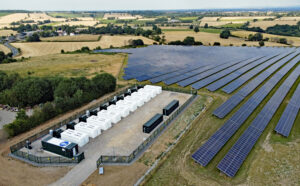


- The 850 MW / 1,680 MWh Waratah Super Battery has received approval to operate at full capacity. Its main purpose is to prevent network failures and increase the capacity of existing transmission lines.
- The project attracted more than A$1bn of private investment but suffered a major transformer failure during commissioning.
- Waratah demonstrates a procurement model that pays batteries for network resilience rather than relying solely on volatile merchant revenues.
Australia’s most powerful battery has entered full commercial operation in New South Wales, completing a project designed to use fast-acting storage as an alternative to immediately constructing new transmission capacity.
The Waratah Super Battery can discharge 850 MW and store 1,680 MWh, giving it a duration of almost two hours at maximum output. The Australian Energy Market Operator has now approved full-capacity operation following an extended commissioning period.
Built at the former Munmorah coal-fired power station, the facility is owned and operated by BlackRock-backed Akaysha Energy. More than A$1bn of private investment was attracted to the project, with approximately 1,000 people involved in design and construction.
Waratah’s defining feature is its integration with Transgrid’s System Integrity Protection Scheme. The control system monitors 36 transmission lines and can instruct the battery to inject electricity within seconds when outages or overloads threaten the network. Paired generators can simultaneously be told to reduce output, restoring the system to a secure operating condition.
This arrangement allows transmission lines serving Sydney, the Hunter and Illawarra regions to carry more electricity during normal operation. The battery stands ready to respond if a lightning strike, bushfire or equipment failure removes a line. EnergyCo describes it as a “shock absorber” for the network.
The system is intended to provide this role until the Hunter Transmission Project is operational. It can also trade electricity and provide other grid services when capacity is not reserved for system protection.
Mission-critical components
Waratah’s procurement model is as important as its engineering. Akaysha contracted to provide at least 700 MW and 1,400 MWh for the system integrity service. Its additional 150 MW and 280 MWh can operate outside that minimum commitment, while more capacity may become available to the market when not reserved under the contract.
The Australian Energy Regulator previously determined that Transgrid could recover A$705.2mn over the five years to June 2029 for the battery service, control system, paired generation and associated network works. These regulated payments are separate from the more than A$1bn of private investment reported by EnergyCo.
This mixture of contracted availability and merchant opportunity provides a more bankable revenue base than dependence on energy price spreads alone. It also lets network planners compare battery expenditure with the cost and lead time of conventional transmission reinforcement.
Delivery was not straightforward. After briefly reaching 850 MW in October 2025, a high-voltage transformer suffered what industry reporting described as a catastrophic failure. The facility fell to 350 MW before returning to 700 MW in June 2026; a replacement transformer was required before final commissioning. Regulatory payments were adjusted to reflect the delay.
The episode is a useful counter to claims that batteries are simple, modular infrastructure. At this scale, transformers, power-conversion equipment, controls and grid models are mission-critical components with long replacement lead times. Waratah includes 288 Hitachi Energy power-conversion systems, two plant controllers and a 20-year digital service agreement.
The UK has a rapidly growing battery fleet but persistent transmission constraints, particularly between renewable generation regions and major demand centres. Waratah shows how storage can be procured as network infrastructure, with performance obligations and availability revenue, rather than treated solely as a merchant generator.
It is not a substitute for every transmission project: its stored energy is limited, and EnergyCo itself describes it as an interim support until new lines arrive. But it demonstrates that batteries can increase the usable capacity of existing infrastructure while slower network construction catches up. That may be more valuable to Britain than another project competing for the same increasingly crowded frequency response and wholesale arbitrage revenues.