

- A Masdar-led solar and battery project in Abu Dhabi has reached financial close, securing $5.1bn in financing from thirteen banks.
- Masdar will contribute $1bn of equity, with the scheme targeting 1 GW of continuous power from 2027.
- Financial close proves appetite for the model, but undisclosed tariff and financing terms limit direct cost comparisons with gas, nuclear or UK renewables.
Masdar has reached financial close on a $6.1bn solar and battery project designed to supply 1 GW of continuous electricity, marking the largest financing test yet for renewables configured as firm power.
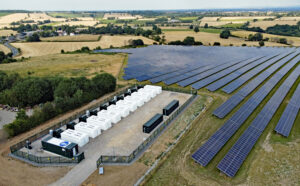
The Abu Dhabi project will combine 5.2 GW of photovoltaic capacity with a 19 GWh battery system. Masdar and the Emirates Water and Electricity Company expect it to enter operation in 2027 after construction began in October 2025.
A group of 13 international and Emirati banks is providing $5.1bn of financing, with Masdar supplying $1bn of equity. The debt providers include HSBC, Standard Chartered, BNP Paribas, KfW IPEX-Bank, Bank of China, Sumitomo Mitsui Banking Corporation and several UAE lenders. The project is therefore roughly 84% debt-financed.
Masdar describes the development as the world’s first “gigascale” round-the-clock renewable energy project. The company says it will provide 1 GW continuously, rather than merely matching that output on an annual basis. Its financial-close announcement does not disclose the debt tenor, financing margin, electricity tariff or detailed offtake terms.
The system’s scale illustrates the physical requirements. Solar capacity will be more than five times the promised continuous output, while 19 GWh of batteries is nominally sufficient to provide 1 GW for 19 hours. Actual operation will depend on usable battery capacity, degradation allowances, charging losses and the project’s reserve margin.
BYD Energy Storage has separately agreed to supply 11.275 GWh of the battery capacity, representing most of the total system, according to ESS News. The scale of that order alone is comparable with the annual deployment of some national storage markets.
The concept was announced in January 2025 and broke ground nine months later. Financial close is the more significant milestone because it shows that commercial lenders are prepared to accept the construction, operating and degradation risks involved in combining solar and batteries at this scale.
Defined power profile
Falling battery prices have made the project possible. Ember estimates that storage costs have declined by about 20% a year over the past decade, putting the average cost of dispatchable solar in suitable markets outside China and the US at about $76/MWh. That is a general benchmark rather than the price of Masdar’s project, which has not been disclosed.
Abu Dhabi has abundant land, strong year-round irradiation and limited winter seasonality. Countries like the UK cannot reproduce the same output profile by applying the same ratio of panels to batteries. Its weakest solar period coincides with high winter demand, requiring wind, interconnection, long-duration storage or firm generation alongside batteries.
The financing model is nevertheless important. Most renewable procurement still buys intermittent megawatt-hours and leaves the system operator or customer to procure firmness separately. Masdar is attempting to sell a defined power profile, integrating generation and storage behind one financing structure.
That approach could inform corporate power contracts, data centre supply and future renewable auctions in Britain. It also changes the relevant comparison – the project is not competing solely with an unfirmed solar farm, but with the combined cost of generation, balancing, capacity and fuel-price protection.
The missing commercial disclosures prevent a definitive judgment on whether it can beat new gas or nuclear generation without state-backed terms. What financial close establishes is narrower but still significant: dispatchable solar-plus-storage has moved from a technical proposition to a bankable infrastructure category at multibillion-dollar scale.